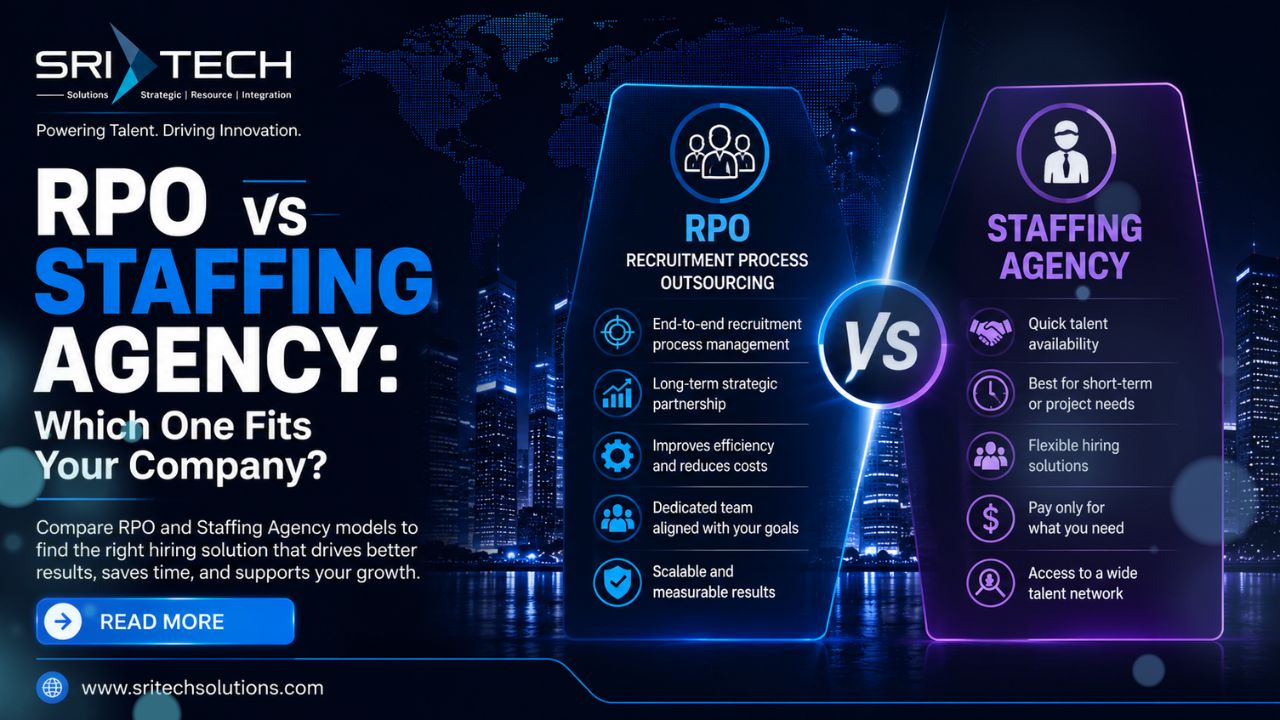
RPO vs Staffing Agency: Which One Fits Your Company?
Introduction
RPO vs staffing agency is the wrong question for a lot of companies — not because the comparison doesn’t matter, but because many end up needing both, just for different problems. Still, if you’re staring down a hiring plan and trying to decide where your budget should go first, the distinction matters enormously, and getting it wrong is an expensive mistake to unwind six months in.
This guide gives you a direct, practical answer: what actually separates these two models, what each one costs, which situations favor which approach, and how to combine them without wasting money on redundant recruiting spend. For the full mechanics of how RPO itself works day-to-day, see our companion guide: RPO Services USA: Recruitment Process Outsourcing Explained.
The Core Difference,
A staffing agency fills individual, specific roles — you tell them what you need, they source and present candidates, you hire, they get paid per placement. RPO (Recruitment Process Outsourcing) works differently: instead of filling one role at a time, an RPO provider takes over all or part of your recruiting function — running it as an embedded extension of your HR team, under your employer brand, accountable for outcomes like time-to-fill and pipeline quality across your entire hiring volume, not just one seat.
Put simply: a staffing agency sells you placements. An RPO provider sells you recruiting capacity and process. Neither description is a value judgment — a company that needs three specialized hires this quarter and a company that needs to fill forty standardized roles a year are solving fundamentally different problems, and the right model follows from which problem you actually have.
The Problem: Picking the Wrong Model Wastes Budget
Here’s where companies actually get stuck:
- Leadership approves a big hiring push, and someone defaults to “call our staffing agency” — but the volume is high enough that per-placement fees balloon past what a managed RPO engagement would have cost.
- A company signs an enterprise RPO contract for what turns out to be three hard-to-fill specialist roles a year — a fraction of the volume RPO is built to justify.
- Internal HR is stretched thin, but leadership assumes the only option is hiring more in-house recruiters, when a hybrid model would solve the capacity problem faster and cheaper.
- Nobody revisits the decision as hiring volume changes, so a company stays locked into the wrong model for years.
Consequently, the real cost of this decision isn’t just fees — it’s mismatched capacity. Too much overhead for your volume, or too little recruiting horsepower to hit your hiring targets, either way it shows up in your time-to-fill numbers within a quarter.
The RPO vs staffing agency decision also tends to get made once, by whoever happened to be in the room during a budget cycle, and then never revisited. That’s a problem because hiring needs shift — a company that hired 8 people last year might need 40 this year after a funding round or a new product launch, and the model that made sense at the old volume can quietly become the wrong one without anybody noticing until costs or vacancy rates start climbing.
Staffing Industry Data You Should Know
- Staffing Industry Analysts forecasts the US staffing market will grow to roughly $180 billion in 2026, with IT staffing among the segments showing renewed momentum after a slower 2024–2025 stretch.
- The American Staffing Association reports that America’s staffing companies employed close to 11 million people in 2024, with nearly 2.2 million temporary and contract employees working for staffing firms in an average week.
- Industry research from Gartner continues to identify talent scarcity as a top-three operational risk cited by HR and business leaders heading into 2026.
- On-demand and project-based RPO engagement models are consistently cited by industry researchers as the fastest-growing segment of the RPO market, reflecting demand from companies that need scalable recruiting capacity without a multi-year commitment.
The takeaway: neither model is disappearing, and that’s the point — RPO and staffing agencies solve genuinely different problems, and the fastest-growing parts of both markets are the flexible, on-demand versions built for companies who don’t want to overcommit either way.
2026 Trends in Recruiting Models
1. Hybrid engagement is now the default, not the exception. More companies run a staffing agency relationship for niche, hard-to-fill roles alongside an RPO partner (or in-house team) handling their steady-state volume hiring.
2. On-demand RPO is closing the gap with staffing agencies. Modular RPO — recruiting capacity added for weeks or months, billed on usage rather than a long contract — now competes directly with staffing agencies for companies that previously assumed RPO meant a multi-year commitment.
3. AI-driven sourcing is compressing the cost advantage of scale. RPO providers using AI-assisted sourcing and screening can now run leaner teams at higher volume, which is narrowing the price gap between RPO and traditional staffing for mid-sized hiring plans.
4. CFOs are pushing for cost predictability. RPO’s fee structures — monthly retainer, cost-per-hire, or hybrid — appeal to finance leaders who want predictable recruiting spend instead of variable per-placement fees that spike during hiring surges.
5. Compliance and employer-brand consistency matter more. As remote and hybrid hiring spans more states and countries, companies increasingly value RPO’s single point of accountability for both compliance and consistent candidate experience under their own brand.
RPO vs Staffing Agency vs Staff Augmentation: Full Comparison
When people ask about RPO vs staffing agency, they’re often really asking about three models at once, because staff augmentation frequently enters the conversation too. The table below lays out all three side by side, since most hiring plans end up drawing from more than one.
| Factor | Staffing Agency | RPO | Staff Augmentation |
|---|---|---|---|
| What you’re buying | Individual placements | Recruiting process/capacity | Extra hands on your team |
| Who owns the process | The agency, per role | The RPO provider, across your hiring function | Your internal managers |
| Pricing model | Per-placement fee (% of salary or flat) | Retainer, cost-per-hire, or hybrid | Hourly/monthly rate |
| Best for | Low-to-moderate volume, urgent or niche roles | Sustained or high-volume hiring | Filling skill/capacity gaps on existing projects |
| Employer brand | Agency’s own outreach | Recruits under your brand | N/A — internal role |
| Speed to start | Days to weeks per role | Weeks (onboarding/discovery phase) | Days to 2-3 weeks |
| Ideal engagement length | Transactional, one role at a time | Ongoing, typically 12+ months | Weeks to 12+ months |
| Cost predictability | Variable — scales with headcount need | High — fixed retainer/fee structure | Moderate — hourly, scales with usage |
If you’re not sure which column fits, our IT Staff Augmentation Services guide covers that third model in depth for teams that need to extend capacity rather than outsource recruiting itself.
A Step-by-Step Framework for Choosing
Step 1: Count your annual hiring volume. Under roughly 15–20 hires a year, a staffing agency relationship is usually more cost-effective. Above that, RPO’s fixed-fee structure typically starts winning on cost-per-hire.
Step 2: Assess how specialized the roles are. Highly niche, hard-to-fill technical roles (VLSI, embedded systems, senior AI/ML) often justify a specialized staffing partner even at lower volume, because the sourcing expertise matters more than process scale.
Step 3: Look at your internal HR bandwidth. If your internal team is drowning in requisitions with no time for strategy, RPO’s embedded model frees them up. If your team just needs occasional backup on hard searches, a staffing agency plugs that gap without restructuring anything.
Step 4: Map your hiring timeline. Need someone in two weeks? A staffing agency with an active candidate pipeline will typically outpace an RPO engagement’s ramp-up phase. Building a 12-month hiring plan? RPO’s discovery and process-design phase pays off over that horizon.
Step 5: Decide if you need one, or both. Many companies run RPO for steady-state, high-volume hiring and keep a staffing agency relationship on standby for urgent or highly specialized roles that fall outside the RPO scope. This isn’t redundant — it’s how the two models are usually meant to work together.
Step 6: Set a review cadence. Hiring volume and role mix change. Revisit this decision at least annually — a model that fit last year’s headcount plan may not fit this year’s.
How This Plays Out Specifically in IT and Technology Hiring
The RPO vs staffing agency calculation shifts a bit once you’re specifically hiring for technology roles, and it’s worth calling out directly since that’s the hiring you’re most likely trying to solve.
Specialized technical roles skew the math toward staffing agencies, even at higher volume. VLSI engineers, embedded systems developers, senior AI/ML specialists, and niche cybersecurity roles draw from a genuinely small talent pool. An RPO provider’s process efficiency matters less here than a staffing partner’s existing relationships and pre-vetted bench in that exact specialty — which is why even companies with sustained hiring volume often keep a dedicated technical staffing relationship for these roles specifically, separate from whatever handles their broader hiring.
High-volume, standardized technical hiring is where RPO earns its keep. If you’re scaling a development team and need a steady stream of mid-level engineers, QA analysts, or support staff with well-defined requirements, that’s closer to the volume-driven hiring RPO was built for — repeatable requisitions, consistent screening criteria, and a process that gets more efficient as it runs.
Technical vetting quality matters more than either model’s structure. Whether you’re working with a staffing agency or an RPO provider, ask directly how they technically vet candidates before you ever see a resume. A staffing partner that has invested in real technical screening — live coding assessments, architecture discussions, hands-on evaluation for AI/ML and cloud roles — will outperform a larger provider running generic keyword matching, regardless of which pricing model you choose.
What Each Model Actually Costs
Staffing agency fees typically run 15–25% of a placed employee’s first-year salary for permanent roles, or a marked-up hourly bill rate for contract placements.
RPO pricing generally follows one of three structures:
- Management fee — a fixed monthly retainer covering recruiting capacity, regardless of volume that month
- Cost-per-hire — a set fee per successful hire, often lower than agency fees at volume
- Hybrid — a base retainer plus per-hire or performance-based components
At meaningful hiring volume — generally 20+ hires annually — RPO tends to cost less per hire than a staffing agency, because the provider isn’t restarting the search process from zero each time. Below that volume, the fixed overhead of an RPO engagement often isn’t justified, and per-placement staffing agency fees end up cheaper overall.
It’s worth running the actual math for your own numbers rather than relying on rules of thumb. Take your projected annual hiring volume, multiply it by an estimated average agency fee per hire, and compare that total to what an RPO provider quotes as a monthly or annual retainer. The crossover point — where RPO starts costing less than staffing agency fees — usually lands somewhere between 15 and 25 hires a year, but it shifts based on average salary levels and role complexity, so a quick calculation specific to your hiring plan is worth more than any general benchmark.
Real Client Results
Cybersecurity role open for seven months, filled in four days. A healthcare services client, HealthPlan Services Inc., had struggled to fill a cybersecurity engineering position for seven months before working with SRI Tech Solutions. Working with a staffing agency approach rather than a full RPO engagement — appropriate given the single, highly specialized role — SRI Tech delivered three qualified candidates within days, and the client made a hire that fit both the technical requirement and their compliance-heavy environment.
Field engineer sourced on two weeks’ notice. APR Energy LLC needed an experienced field network engineer with only two weeks before the project start date. Because a staffing agency model meant SRI Tech already had a screened bench of candidates in that specialty, the role was filled inside the deadline — illustrating exactly the scenario where a staffing agency’s speed beats a longer RPO ramp-up.
These aren’t cases where RPO would have been the better fit — they’re useful precisely because they show staffing agency speed and specialization winning for urgent, narrow hiring needs, while sustained high-volume hiring plans are where RPO’s process ownership pays off instead.
It’s worth noting what both stories have in common: a defined, urgent need and a partner with an already-warm candidate pipeline in that specialty. That combination is exactly where a staffing agency outperforms RPO, and exactly why the “which model is better” question only makes sense once you know what you’re actually trying to solve.
Benefits of Each Model
Neither side of the RPO vs staffing agency comparison is universally “better” — each model was built to solve a different shape of hiring problem, and the benefits reflect that.
Staffing agency benefits:
- Fast turnaround for urgent, single-role needs
- No long-term contract commitment
- Access to a specialized, pre-vetted candidate bench for niche skill sets
- Pay only for successful placements
RPO benefits:
- Lower cost-per-hire at meaningful volume
- Consistent candidate experience under your employer brand
- Frees internal HR from high-volume requisition management
- Predictable, budgetable recruiting spend
- Deeper data and reporting on your hiring funnel over time
Taken together, these two lists explain why so many mid-sized and enterprise companies eventually run both models rather than picking a permanent winner.
Challenges and Risks
- Staffing agency risk: costs can add up quickly at high volume, and agency-sourced candidates may not consistently reflect your employer brand or culture the way an embedded RPO team would.
- RPO risk: the discovery and ramp-up phase takes real time — not the right fit if you need someone hired next week. Locking into a long RPO contract for volume that doesn’t materialize also wastes budget.
- Shared risk: both models fail if internal stakeholders aren’t aligned on role requirements upfront — vague job briefs produce mismatched candidates regardless of which model sources them.
None of these risks are reasons to avoid either model outright. They’re reasons to match the model to the situation deliberately, instead of defaulting to whichever one your company happened to use last time.
Mistakes Companies Make
Most of the friction between RPO and staffing agency engagements traces back to a handful of avoidable decisions, made once and never revisited:
- Defaulting to whichever model was used last time, without recalculating volume and role mix.
- Signing a long RPO contract for sporadic hiring needs that never generate the volume to justify the fixed cost.
- Using a staffing agency for high-volume, ongoing hiring and absorbing avoidable per-placement fees that an RPO retainer would have reduced.
- Skipping the internal capacity assessment — bringing in either model without first understanding what your in-house HR team can and can’t handle.
- Treating the decision as permanent instead of revisiting it as the business changes.
Every one of these is fixable with a scheduled review rather than a total strategy overhaul — which is exactly why the annual (or twice-yearly) revisit in the framework above matters more than getting the initial decision perfectly right.
Best Practices If You Use Both
If your hiring plan genuinely calls for both models — which, per the framework above, is more common than most companies expect — a few practices keep them from working against each other:
- Define clearly which roles route through RPO and which stay with your staffing agency relationship, so the two don’t compete for the same requisitions.
- Give your RPO provider and staffing agency partner visibility into each other’s pipelines if they’re sourcing similar roles, to avoid duplicate outreach to the same candidates.
- Set shared reporting cadences so leadership sees one unified view of hiring performance, not two disconnected dashboards.
- Revisit the split between the two models at least twice a year as hiring volume shifts.
Where This Is Heading in 2026
Expect the line between these models to blur further through the rest of 2026. On-demand and modular RPO structures are increasingly priced and packaged to compete directly with staffing agencies for mid-volume hiring plans, while AI-assisted sourcing is narrowing the cost gap that used to favor agencies at lower volume. Meanwhile, companies with highly specialized, low-volume technical needs — VLSI, embedded systems, senior AI/ML roles — will likely keep favoring specialized staffing agency relationships over RPO regardless of these shifts, simply because sourcing expertise in a narrow niche matters more than process scale.
The companies getting this right in 2026 aren’t picking one model and defending it forever. Instead, they’re mapping hiring volume and role specialization to the right model, revisiting that map regularly, and treating RPO and staffing agencies as complementary tools rather than competing philosophies.
For most mid-sized and enterprise technology companies, that means a working answer to “RPO vs staffing agency” looks less like a single checkbox and more like a routing rule: high-volume, standardized roles go through whichever process-driven model — internal, RPO, or a hybrid — handles repeatable hiring efficiently, while urgent or highly specialized technical roles route to a staffing partner with deep bench strength in that niche. Getting that routing rule right, and revisiting it as the business changes, matters more than which model “wins” in the abstract.
FAQs
What is the difference between RPO and a staffing agency?
A staffing agency fills individual roles for a per-placement fee. RPO takes over all or part of your recruiting function as an embedded, ongoing extension of your HR team, typically under a retainer or cost-per-hire fee structure.
Is RPO cheaper than a staffing agency?
At higher hiring volume — generally above 15–20 hires a year — RPO tends to cost less per hire. At lower volume, staffing agency per-placement fees are usually more cost-effective.
When should a company use RPO instead of a staffing agency?
RPO fits best when you have sustained, high-volume hiring needs and want predictable recruiting costs. A staffing agency fits best for urgent, niche, or lower-volume hiring needs.
Can you use RPO and a staffing agency at the same time?
Yes — many companies run RPO for steady-state, high-volume hiring while keeping a staffing agency relationship for urgent or highly specialized roles outside the RPO scope.
What are the disadvantages of RPO?
The discovery and ramp-up phase takes time, making RPO a poor fit for urgent single-role needs. Long-term RPO contracts can also become poor value if hiring volume drops.
How is RPO priced compared to staffing agency fees?
Staffing agencies typically charge 15–25% of first-year salary per placement. RPO uses a monthly retainer, cost-per-hire, or hybrid model, generally structured for cost predictability at volume.
Does RPO replace an internal HR team?
No — RPO is designed to work as an extension of your internal HR team, not a replacement. Internal HR typically retains strategic ownership while the RPO provider executes the recruiting process.
What size company benefits most from RPO?
Companies with sustained hiring volume — generally 20 or more hires annually — see the strongest cost and efficiency benefits from RPO. Smaller or sporadic hiring needs are usually better served by a staffing agency.
Conclusion
RPO vs staffing agency isn’t really a competition — it’s a fit question, and the honest answer depends on your hiring volume, how specialized your roles are, and how much bandwidth your internal HR team has. High-volume, sustained hiring generally favors RPO’s cost predictability and process ownership. Urgent, niche, or lower-volume hiring generally favors a staffing agency’s speed and specialization. Many of the companies getting the best results are using both, mapped deliberately to the roles each model handles best.