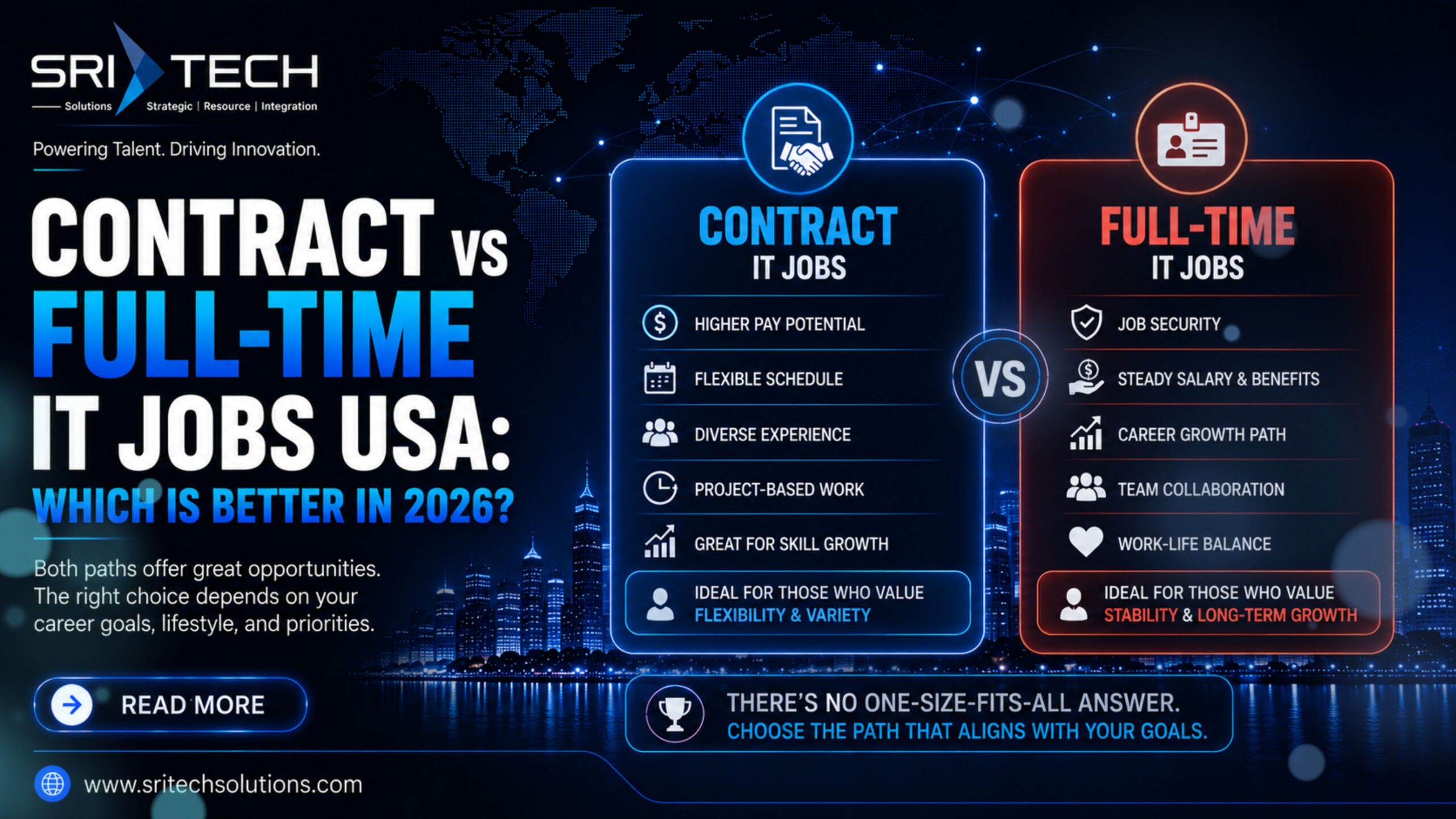
One of the most common questions IT professionals ask in 2026 is also one of the most important: should I take a contract IT job or hold out for a full-time position?
And on the employer side: should we hire a contract IT professional or commit to a permanent hire?
The answer to both questions has shifted significantly in 2026 — and the data may surprise you.
Contract-to-hire has overtaken direct hire as the default model for senior IT roles across the US market. More than 66% of technology leaders say they expect to bring in more contract professionals in the second half of 2026, while 78% plan to increase permanent headcount too. Companies are no longer treating contract and full-time as an either-or choice — they are building hybrid workforces that use both strategically.
For IT professionals, understanding the difference between contract and full-time IT jobs in the USA — the real financial picture, the career implications, the risk profile, and the 2026 market dynamics — is one of the most valuable things you can do before your next career move.
This guide breaks it all down clearly so you can make the right decision for your situation.
What Is a Contract IT Job?
A contract IT job is a fixed-term engagement where you are hired to deliver a specific outcome or support a project for a defined period — typically 3, 6, or 12 months, with options to extend. You may be employed directly by the client company or through a staffing agency that manages your payroll, benefits, and compliance.
Contract IT roles exist across every specialization — cloud engineering, cybersecurity, AI/ML, ServiceNow, DevOps, data engineering, and software development. They are used by companies that need specialized skills for a defined initiative, want to evaluate talent before committing to a permanent hire, or need to scale headcount flexibly without long-term fixed costs.
There are three main types of contract IT arrangements in the US market:
Contract (Pure Contract): A fixed-term engagement with no expectation of conversion to permanent employment. You are hired for a project and the engagement ends when the project is complete or the contract term expires.
Contract-to-Hire (C2H): A contract engagement that includes a mutual option to convert to a full-time permanent role after a defined period — typically 3 to 6 months. This is the fastest-growing model in US IT staffing in 2026.
Corp-to-Corp (C2C): An arrangement where you operate as an independent contractor through your own LLC or S-Corp, billing the client directly or through a staffing agency. This model offers the highest earning potential but requires you to manage your own business, taxes, and insurance.
What Is a Full-Time IT Job?
A full-time IT job is a permanent employment arrangement with a single employer — typically offering a fixed annual salary, health insurance, retirement benefits (401k with employer match), paid time off, and various other employment benefits.
Full-time IT roles provide the greatest stability and the most structured career development pathway. They typically include performance reviews, promotion opportunities, and employer-sponsored training and certification programs.
In 2026, full-time IT positions are most common for core infrastructure roles — IT managers, security architects, cloud platform owners, and enterprise system administrators who are critical to ongoing operations rather than specific projects.
Contract vs Full-Time IT Jobs — The Financial Reality in 2026
This is where most comparisons go wrong. The headline salary numbers do not tell the full story.
Contract IT Jobs — The Pay Premium
Contract IT professionals in the USA command a significant hourly rate premium over their full-time equivalents. The reason is simple: contract professionals do not receive employer-paid benefits, they cover their own taxes (including self-employment tax in Corp-to-Corp arrangements), and they absorb the risk of gaps between contracts.
The general rule in US IT contracting: your hourly contract rate should be approximately 50% to 75% higher than the equivalent full-time rate to achieve comparable total compensation after accounting for benefits, taxes, and downtime.
Real example:
A full-time cloud engineer earning $130,000 per year receives roughly $150,000 to $165,000 in total compensation when employer-paid health insurance, 401k match, paid time off, and other benefits are factored in.
The equivalent contract cloud engineer should be billing at $90 to $110 per hour — which at 2,000 billable hours generates $180,000 to $220,000 in gross revenue. After self-employment taxes, health insurance, and other business costs, net take-home is roughly comparable to or higher than the full-time equivalent.
For senior IT professionals with in-demand skills — AI engineers, cloud architects, cybersecurity specialists, ServiceNow architects — the contract premium is real and meaningful. Many senior IT contractors in the USA are clearing $150,000 to $250,000+ per year in 2026.
Full-Time IT Jobs — The Benefits Advantage
The financial case for full-time employment is strongest when employer benefits are genuinely valuable — particularly employer-sponsored health insurance, 401k matching, and equity (RSUs or stock options) at technology companies.
For professionals earlier in their career, the structured development, mentorship, and employer-sponsored certification programs that come with full-time employment often accelerate long-term earning potential more than the short-term contract premium.
2026 Salary Comparison: Contract vs Full-Time
| IT Role | Full-Time Salary | Contract Rate | Annual Contract Gross |
|---|---|---|---|
| AI / ML Engineer | $140,000 – $200,000 | $100 – $145/hr | $200,000 – $290,000 |
| Cloud Architect | $130,000 – $185,000 | $90 – $130/hr | $180,000 – $260,000 |
| Cybersecurity Engineer | $120,000 – $175,000 | $85 – $125/hr | $170,000 – $250,000 |
| ServiceNow Architect | $141,000 – $220,000 | $95 – $150/hr | $190,000 – $300,000 |
| DevOps / SRE | $115,000 – $170,000 | $85 – $120/hr | $170,000 – $240,000 |
| Data Engineer | $100,000 – $160,000 | $75 – $115/hr | $150,000 – $230,000 |
| ServiceNow Developer | $101,000 – $186,000 | $70 – $110/hr | $140,000 – $220,000 |
| Cybersecurity Analyst | $85,000 – $130,000 | $60 – $90/hr | $120,000 – $180,000 |
Sources: Robert Half 2026 Salary Guide, KORE1 IT Staffing Trends 2026, Glassdoor July 2026
Pros and Cons: Contract IT Jobs
Pros
Higher hourly earning potential. For senior IT professionals with in-demand skills, contract rates consistently outperform equivalent full-time base salaries — sometimes significantly.
Variety and accelerated learning. Contract work exposes you to different organizations, tech stacks, and business problems in a compressed timeframe — building a breadth of experience that full-time employment at a single company rarely matches.
Flexibility and control. Contract work gives you control over your schedule between engagements, the ability to take breaks between contracts, and the freedom to decline extensions that are not in your interest.
Faster access to senior roles. Companies often bring in contractors for senior-level work that they would take months to hire full-time for. Contract work can get you into CTO-level projects earlier in your career than a traditional full-time path would allow.
Test-drive employers. Contract-to-hire arrangements let you evaluate a company’s culture, leadership, and team before committing to permanent employment — a significant advantage in a market where bad cultural fits cost both sides considerable time and money.
Cons
No employer-sponsored benefits. Health insurance, retirement contributions, and paid time off are your responsibility. These costs are significant and must be factored into your rate negotiation.
Income instability. Gaps between contracts are part of the model. Most experienced IT contractors plan for 6 to 8 weeks of downtime per year and set their rates accordingly.
No equity upside. Contract workers do not typically receive stock options or RSUs — which at high-growth technology companies can represent significant long-term value.
Visa complexity. For H-1B visa holders, contract arrangements require careful legal structuring. Not all contract models are straightforwardly compatible with H-1B status — specialist guidance is important.
Pros and Cons: Full-Time IT Jobs
Pros
Stability and predictability. A fixed salary, consistent benefits, and structured career progression are significant advantages — particularly for professionals with financial commitments or family responsibilities.
Employer-sponsored benefits. Health insurance, 401k matching, paid time off, parental leave, and professional development budgets are genuine financial advantages that contract workers must fund themselves.
Equity participation. At technology companies that offer RSUs or stock options, full-time employment can generate significant additional wealth — particularly at growth-stage companies where equity is meaningful.
Visa and green card support. Full-time permanent employment is the standard pathway for H-1B visa holders and the prerequisite for PERM green card sponsorship. For professionals pursuing long-term US residency, a full-time role at a sponsoring employer is typically essential.
Structured career development. Performance review cycles, promotion tracks, mentorship programs, and employer-funded certifications all accelerate career development in ways that contract work does not typically replicate.
Cons
Lower near-term earning potential. For senior IT professionals, the all-in full-time compensation package is typically lower than what an equivalent contract rate generates — particularly for highly specialized skills in short supply.
Less flexibility. Full-time employment comes with expectations of availability, limited control over work focus, and corporate processes that contract professionals can often sidestep.
Slower access to diverse experience. Building a broad portfolio of different companies, industries, and tech stacks takes significantly longer through full-time employment than contract work.
What the 2026 Market Data Is Telling Us
The US IT market in 2026 is sending clear signals about where it is moving.
Contract-to-hire is overtaking direct hire as the default model for senior IT roles. Companies are using contract arrangements to evaluate talent in real conditions before committing to permanent employment — reducing the risk of expensive mis-hires at the senior level. For candidates, this means contract engagements are increasingly a pathway into full-time employment rather than an alternative to it.
Clients want to scale up quickly for specific initiatives and then scale back without long-term fixed costs. This environment favors IT professionals who can step into high-impact project roles quickly — and rewards those with demonstrated ability to deliver in contract environments.
More than 71% of technology leaders say skills shortages have caused project delays in the past year, and nearly half report projects canceled entirely due to talent gaps. This pressure is creating genuine urgency around contract hiring — companies need specialized IT professionals fast and are willing to pay contract premiums to get them.
At the same time, 78% of tech leaders plan to increase permanent headcount in the second half of 2026 — the highest level of full-time hiring intent in two years. The market is not choosing between contract and permanent. It is doing both simultaneously.
Which Model Is Right for You?
The honest answer depends on your situation, career stage, and priorities.
Choose contract IT work if:
- You have 5+ years of specialized experience in a high-demand IT skill
- You value income maximization and are comfortable managing your own benefits
- You want variety and accelerated experience across multiple employers
- You are open to contract-to-hire as a pathway into a specific company
- You are not currently dependent on employer visa sponsorship
Choose full-time IT employment if:
- You are earlier in your career and value structured development and mentorship
- You need employer-sponsored health insurance or are supporting a family
- You are pursuing H-1B visa status or green card sponsorship
- You want equity participation at a specific company
- You value long-term stability over short-term income maximization
Consider contract-to-hire if:
- You want to evaluate a company before making a permanent commitment
- You are returning to the US market or transitioning to a new specialization
- You want full-time employment but want to accelerate your entry into a specific company
How SRI Tech Solutions Places Both Contract and Full-Time IT Professionals
At SRI Tech Solutions, we work with both engagement models — placing IT professionals in contract, contract-to-hire, and full-time permanent roles with US companies across cloud engineering, cybersecurity, AI/ML, ServiceNow, and DevOps.
For candidates, we match your skills, goals, and situation to the right opportunity — whether that means a high-rate contract role that maximizes your near-term income, a contract-to-hire arrangement at a company you want to evaluate, or a permanent placement that supports your visa and long-term career goals.
For employers, we source and vet pre-qualified IT professionals for both contract and permanent needs — delivering shortlists of 3 to 5 candidates per search within 10 to 14 days, regardless of engagement model.
The Bottom Line
The contract vs full-time debate in 2026 does not have a universal right answer — it has a right answer for your specific skills, career stage, and priorities.
What the data makes clear is that both models are growing. Contract IT work offers real financial upside for experienced professionals with in-demand skills. Full-time employment offers stability, benefits, and visa pathways that contract work cannot replicate. And contract-to-hire is rapidly becoming the smartest bridge between the two.
Understanding both models — and choosing strategically based on your own situation — is one of the highest-value decisions you can make in your IT career in 2026.
Ready to Find the Right IT Opportunity — Contract or Full-Time?
At SRI Tech Solutions, we specialize in placing IT professionals across both contract and full-time engagements with US companies — across cloud, cybersecurity, AI, ServiceNow, and DevOps.
Whether you are looking for a high-rate contract role or a permanent placement with visa sponsorship support, we have the network and 20+ years of experience to find the right match.
📩 Submit your profile today — or browse our current IT openings to find your next opportunity.