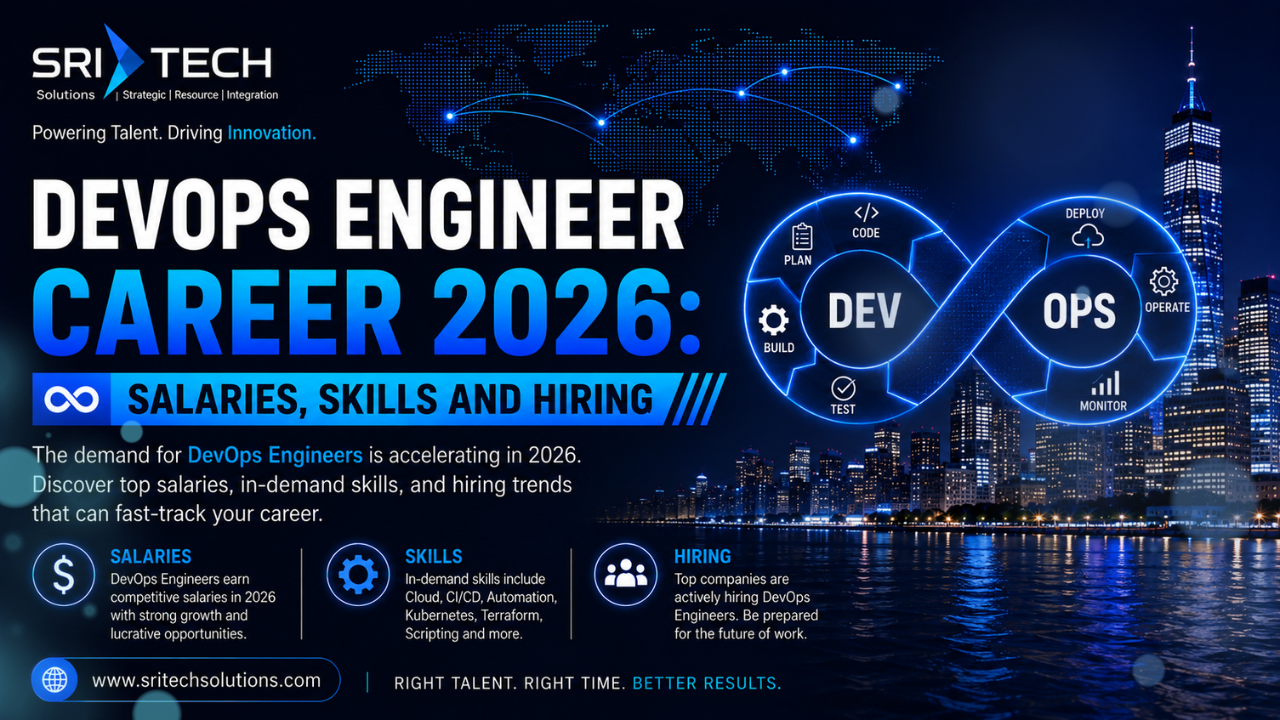
A DevOps engineer career in 2026 sits at one of the most favorable intersections in all of technology: high demand, severe talent scarcity, and compensation that keeps climbing year over year.
The salary picture tells the story. Specifically, Robert Half places DevOps engineer ranges between $118,000 and $173,750. Meanwhile, the US median base sits around $148,000. However, senior DevOps engineers with Kubernetes or AWS certifications regularly clear $190,000. Additionally, engineers in platform engineering and SRE roles at high-growth companies reach $225,000 and beyond.
These figures reflect a 6% to 8% year-over-year increase. Notably, that growth is driven by persistent demand for infrastructure automation, platform engineering, and cloud-native delivery pipelines.
However, the most interesting insight in the 2026 data is not the headline number. Instead, it is the gap between engineers who have production Kubernetes experience and those who do not. Specifically, that single differentiator consistently adds $15,000 to $25,000 to compensation.
This guide covers the full picture: the roles, the salary bands, the skills that actually move your number, and the path to landing a DevOps position in 2026.
Why DevOps Demand Remains Strong in 2026
First, understand what is driving this market.
Software delivery velocity has become a genuine competitive differentiator. Consequently, companies that ship reliably and frequently outperform those that do not. Therefore, the engineers who build and maintain that delivery capability remain essential.
Additionally, DevOps roles fall within the broader software development occupational category, where the Bureau of Labor Statistics projects 15% job growth between 2024 and 2034 — well above the average across all US occupations.
However, the biggest accelerant in 2026 is artificial intelligence infrastructure. Specifically, training and serving machine learning models requires specialized infrastructure: GPU clusters, model registries, feature stores, and ML pipelines. As a result, DevOps engineers with MLOps experience command premium salaries as companies race to productionize AI.
Meanwhile, the role itself continues evolving. Notably, it is shifting toward platform engineering and DevSecOps. However, the underlying demand is not softening. Instead, the expectations are simply broadening.
Top DevOps Roles in 2026
1. DevOps Engineer
This remains the most common title and the primary entry point. Specifically, DevOps engineers build and maintain CI/CD pipelines, write infrastructure as code, manage containerized workloads, and implement monitoring and observability.
However, the degree of emphasis varies considerably by company. Therefore, always clarify during interviews which of these areas dominates the actual day-to-day work.
What employers want: CI/CD tooling (GitHub Actions, Jenkins), Terraform, Docker, Kubernetes, and scripting in Python or Bash.
Salary Range: $118,000 – $175,000
2. Site Reliability Engineer (SRE)
SRE shares the reliability and on-call half of DevOps work. However, it leans considerably harder on error budgets, service level objectives, and monitoring than on building platform tooling.
Additionally, SRE roles typically require deeper systems fundamentals — networking, distributed systems, and incident response methodology.
What employers want: Observability tooling, incident management experience, SLO design, and strong debugging skills under pressure.
Salary Range: $130,000 – $200,000
3. Platform Engineer
Platform engineering has become one of the fastest-growing DevOps specializations. Essentially, a platform engineer builds the internal tooling and abstractions that let application teams deploy independently and safely.
Notably, this title tends to sit at or above the general DevOps median. Because the mandate is wider and the impact more visible, compensation reflects it.
What employers want: Kubernetes at production depth, internal developer platform experience, GitOps workflows, and strong API design sense.
Salary Range: $140,000 – $210,000
4. Kubernetes Engineer
Kubernetes engineers design, run, and secure the container platform that a company’s applications live on. Notably, the median base sits near $140,000.
However, the certification landscape reveals something interesting. Specifically, the Certified Kubernetes Administrator (CKA) stands out because Kubernetes expertise is required for the majority of mid-to-senior DevOps roles — yet the certification pass rate remains below 60%. Consequently, scarcity plus demand produces a genuine premium.
What employers want: Production cluster management, Helm, service meshes (Istio, Linkerd), and multi-cluster experience.
Salary Range: $125,000 – $190,000
5. DevSecOps Engineer
As security shifts left into the delivery pipeline, DevSecOps has emerged as a distinct and well-compensated specialization. Specifically, these engineers embed security scanning, policy enforcement, and compliance validation directly into CI/CD workflows.
Furthermore, this hybrid profile — DevOps depth plus security fundamentals — remains genuinely rare in the market.
What employers want: Container security, secrets management, policy-as-code (OPA), and vulnerability scanning integration.
Salary Range: $135,000 – $195,000
6. MLOps / AI Infrastructure Engineer
This is the newest DevOps specialization and currently the one with the highest ceiling. Specifically, MLOps engineers build the infrastructure that trains, serves, and monitors machine learning models in production.
Additionally, because the talent pool is extremely thin, companies racing to productionize AI are paying accordingly.
What employers want: GPU cluster management, model serving architecture, ML pipeline orchestration, and cost optimization for AI workloads.
Salary Range: $150,000 – $225,000+
DevOps Salary Guide for 2026
| Role | Experience Level | Salary Range (USA) |
|---|---|---|
| Junior DevOps Engineer | 0 – 2 years | $100,000 – $140,000 |
| DevOps Engineer (Mid) | 3 – 6 years | $118,000 – $175,000 |
| Kubernetes Engineer | 3 – 7 years | $125,000 – $190,000 |
| Site Reliability Engineer | 4 – 8 years | $130,000 – $200,000 |
| DevSecOps Engineer | 4 – 8 years | $135,000 – $195,000 |
| Platform Engineer | 5+ years | $140,000 – $210,000 |
| MLOps / AI Infrastructure | 5+ years | $150,000 – $225,000+ |
Sources: Robert Half 2026 Salary Guide, KORE1 DevOps Salary Guide June 2026, Citadel Cloud Management July 2026, Coursera April 2026, HackerX 2026
Notably, engineers with 10 to 14 years of experience report average base salaries around $179,000.
The Skills That Actually Move Your Salary
Not all DevOps skills carry equal weight. Specifically, the 2026 data points to four clear differentiators.
Production Kubernetes experience. This is the single largest lever. Notably, engineers with genuine production Kubernetes experience consistently command $15,000 to $25,000 more than those without it.
The reason is straightforward. Because hiring managers who have debugged a networking failure in a production multi-tenant cluster at 2am know exactly what questions reveal real experience versus tutorial familiarity, that gap surfaces in the first technical conversation. Therefore, lab experience does not substitute.
Terraform at production level. Terraform appears in roughly two-thirds of current DevOps postings. However, the distinction matters: writing and maintaining real modules differs enormously from copy-pasting from the registry. Consequently, engineers without production-level IaC experience sit in a different tier than roles paying $140,000 and above.
Deep AWS knowledge. AWS holds roughly 31% of global cloud market share. Therefore, deep platform knowledge functions as its own compensation category rather than a generic checkbox.
Specialization stacking. Notably, combinations outperform single skills. Specifically, AWS plus Kubernetes plus security pays meaningfully more than AWS alone. Therefore, deliberate skill stacking produces compounding returns.
The DevOps Certification Path
Certifications serve as verifiable skill signals. However, not all carry equal weight.
Tier 1 — Highest impact. The Certified Kubernetes Administrator (CKA) leads here, largely because of its sub-60% pass rate combined with universal demand. Additionally, AWS Certified DevOps Engineer Professional carries strong weight.
Tier 2 — Strong supporting credentials. HashiCorp Certified Terraform Associate, Certified Kubernetes Application Developer (CKAD), and Azure DevOps Engineer Expert (AZ-400) all strengthen candidacy meaningfully.
Tier 3 — Specialization signals. Certified Kubernetes Security Specialist (CKS) and cloud security certifications open DevSecOps pathways specifically.
Importantly, stacking certifications produces compounding returns rather than diminishing ones.
How to Break Into DevOps
Step 1 — Build Systems Fundamentals First
Before tools, learn fundamentals. Specifically, understand Linux administration, networking basics, and how distributed systems fail. Consequently, everything else becomes considerably easier to learn properly rather than superficially.
Step 2 — Learn One Cloud Platform Deeply
Choose AWS for the largest job market or Azure for enterprise and government opportunities. Then go deep rather than broad. Additionally, pursue an associate-level certification to establish credibility.
Step 3 — Get Real Kubernetes Experience
This is the highest-leverage investment available. However, tutorial completion is not sufficient. Therefore, run a real cluster, break it deliberately, debug the failures, handle upgrades, and document what you learned. Then pursue CKA certification.
Step 4 — Master Terraform Properly
Write actual modules. Manage state across environments. Integrate with CI/CD. Consequently, you move from the copy-paste tier into the tier that commands $140,000 and above.
Step 5 — Talk About Systems, Not Just Tools
Any engineer can list Kubernetes, Terraform, and Docker on a resume. However, what companies want to hear is how you used these tools to solve real problems. Therefore, describe the architecture decisions you made, the tradeoffs you evaluated, and the measurable improvements you achieved.
Additionally, demonstrate business impact. Specifically, faster deployments mean faster feature delivery. Better reliability means happier customers. Infrastructure optimization reduces cloud spend. Consequently, framing your work in these terms separates you from candidates who only list technologies.
Step 6 — Work With a Specialist IT Staffing Partner
Strong DevOps candidates move fast in this market. Specifically, an engineer with three to six years of experience, solid Kubernetes and Terraform, and one major cloud platform typically receives three or four offers within days.
Therefore, being connected to a staffing partner with active client relationships means seeing opportunities early rather than competing in crowded public applications.
A Note for Hiring Managers
The market dynamics here deserve direct attention.
Strong DevOps candidates receive multiple offers within days — not weeks. Consequently, if your process runs six rounds across eight weeks with a take-home project, two technical screens, and compensation committee sign-off before an offer letter goes out, those candidates are gone by round three.
Notably, this pattern repeats constantly. The hiring manager assumes the pipeline dried up. However, it did not. Instead, every strong candidate accepted elsewhere while interviews were being scheduled.
Therefore, three adjustments consistently improve outcomes. First, compress to three interview stages maximum. Second, pre-approve compensation bands before opening the search. Third, empower the hiring manager to extend offers without additional committee review.
The Bottom Line
A DevOps engineer career in 2026 offers strong compensation, sustained demand, and multiple advancement pathways into platform engineering, SRE, DevSecOps, and MLOps.
The salary progression is clear: roughly $100,000 at entry level, $148,000 at the US median, $190,000 for certified senior engineers, and $225,000 or more in platform and MLOps specializations.
Meanwhile, the differentiators are equally clear. Specifically, production Kubernetes experience, production-level Terraform, deep cloud platform knowledge, and deliberate skill stacking separate the engineers commanding premium offers from those competing on volume.
Therefore, for IT professionals evaluating where to invest their next two years, DevOps and platform engineering remain among the most reliable choices available.
Ready to Advance Your DevOps Career?
At SRI Tech Solutions, we have placed DevOps and platform engineering professionals with US companies for over 20 years — spanning DevOps engineers, SREs, Kubernetes specialists, and MLOps engineers.
Furthermore, we maintain direct relationships with US hiring managers building infrastructure teams right now. Consequently, we know which companies are hiring, what they are paying, and how to position your profile effectively.
📩 Submit your profile today — or browse our current DevOps openings to find your next opportunity.